
(Note: This is a re-upload of the post from HalcyonMusic. The original post was lost with the other blog, with the archive available here)
Hello everyone! I’m happy to be invited to share my ideas about writing medleys!
Medleys connect multiple songs / soundtracks together in a single performance. There isn’t a strict standard of how a medley should be written. Creativity is unlimited!
My medley-writing routine goes something like this:
- Setting the theme
- Song choices
- Overarching structure
- Song order
- Writing the transitions
- Review and repeat
Setting the theme
This is the first step – deciding what the medley is about. I think about what’s the story behind the medley and what I’m trying to do.
| Medley | Idea |
|---|---|
| Sword Art Online Medley | Theme songs and soundtracks from the series, must be in chronological order from Seasons 1 to 3 |
| Attack on Titan Medley | Openings and soundtracks from the series |
| 100 Anime Songs Medley | 100 of the most popular anime songs in quick succession, target length of 30 minutes. |
Song choices
After setting the theme, I should already have a list of songs that could be included in the medley. From the list, I separate the list into “must-haves songs” and “supporting songs”. I work on the medley using the must-have list first. As I put the medley together, I use the supporting songs to make transitions smoother and fill in the gaps.
For each song, I take the time to listen carefully and memorize the details as much as I can. At the very least, I should be able to remember how the song goes just by looking at the title. You can’t prepare a good dish without knowing all about its ingredients!
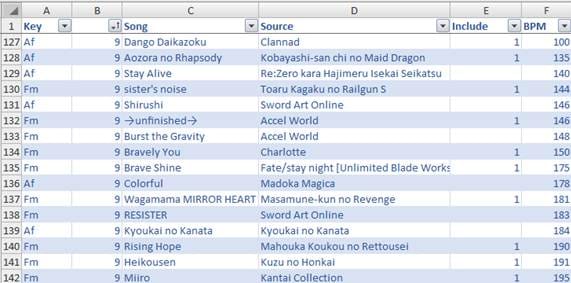
I’ll also write down the tempo, the key and any key changes for each song, which may be useful later. Here’s a sneak peek of my work sheet for the 100 AniSongs medley:
Overarching structure
Before putting the songs in order, I will always start with the overarching structure of the medley. The overarching structure is the outline / shape of the medley. I believe having a well-defined structure separates a “medley” from a “playlist”, and it’s especially important for longer medleys – the structure binds the medley together.
Here are some examples from my medleys:
| Medley | Structure |
|---|---|
| Sword Art Online Medley | Three movements corresponding to seasons 1 to 3. |
| Attack on Titan Medley | Three movements in a “fast-slow-fast” structure. |
| 100 Anime Songs Medley | Roughly five movements in a “fast-slow-fast-slow-fast” structure. |
| K-ON Medley | Songs in chronological order, telling the story from beginning to end. |
Moreover, I like to give listeners the time to rest during a medley. After a long section of fast and upbeat songs, I’ll try to insert a slower section to release the tension, and use the opportunity to add some emotional variety. Because of this, sometimes I would play songs in a different style than the original.
Using the 100 AniSongs medley as an example:
| # | Song | Source | |
|---|---|---|---|
| A | 1 | A Cruel Angel's Thesis | Neon Genesis Evangelion |
| 2 | Netsujou no Spectrum | Nanatsu no Taizai | |
| … | … | … | |
| 12 | Adabana Necromancy | Zombieland Saga | |
| B | 13 | the WORLD | Death Note |
| 14 | Redo | Re:Zero kara Hajimeru Isekai Seikatsu | |
| … | … | … | |
| 43 | Fighting Gold | JoJo no Kimyou na Bouken | |
| C (release) | 44 | Fukashigi no Carte | Seishun Buta Yarou wa Bunny Girl Senpai no Yume wo Minai |
| 45 | Ichiban no Takaramono | Angel Beats! | |
| … | … | … | |
| 48 | MEMORIA | Fate/Zero | |
| D | 49 | CLICK | Nisekoi |
| 50 | COLORS | Code Geass: Hangyaku no Lelouch | |
| … | … | … | |
| 69 | Miiro | Kantai Collection | |
| E (release) | 70 | GATE OF STEINER | Steins;Gate |
| 71 | Toki wo Kizamu Uta | Clannad | |
| … | … | … | |
| 75 | Lapis Lazuli | Arslan Senki | |
| F | 76 | Sugar Song to Bitter Step | Kekkai Sensen |
| 77 | Aozora no Rhapsody | Kobayashi-san chi no Maid Dragon | |
| … | … | … | |
| 94 | M@STERPIECE | iDOLM@STER | |
| G (release) | 95 | THERE IS A REASON | No Game No Life: Zero |
| 96 | God knows… | Suzumiya Haruhi no Yuuutsu | |
| H (Coda) | 97 | Cagayake! GIRLS | K-ON! |
| 98 | Don't say 'lazy' | K-ON! | |
| … | … | … | |
| 101 | Tenshi ni Furetayo | K-ON! |
Song order
A rule of thumb I use when deciding the song order is to consider, in descending order of importance:
- Emotion
- Tempo
- Key
Emotion – it’s the most important aspect. I always group upbeat songs and sentimental songs in their own respective sections. Transitioning between positive and negative emotions too quickly dampens the emotional impact, and makes listeners feel like watching a rushed anime adaptation (*cough* CHAOS;CHILD *cough*).
Tempo – songs of similar tempos go together. It takes a lot of time to transition smoothly between songs that have vastly different tempos. Whenever we listen to music, there’s a mental metronome ticking in our minds, so any sudden tempo changes feel jarring. Below shows the plot of tempos (in BPM) against time of my 100 AniSongs medley:
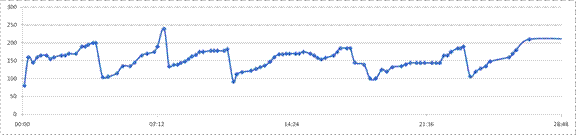
Almost all jumps in the graph are tempo changes where the BPM is about halved (e.g. from 200 BPM to 100 BPM). They let the listeners readjust to a half-time rhythm without the tempo change being explicit.
Key – It’s the easiest to transition between songs that are in the same key, in keys close to each other on the “circle of fifths”, or in keys close to each other on the chromatic scale. We’ll come back to this in a later when I talk about transitions.
Nayu's Note: The original blog post ended here, but with the kind help from HalcyonMusic, who back then was writing the second part, sent me whatever working copy he had :)
Writing the transitions
This is the part I spend the most time on. While there are some general techniques I use often, there is no foolproof formula to do transitions.
Chord progressions
A chord progression is a series of chords in a certain order.
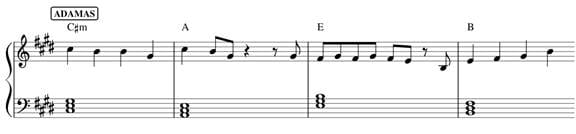
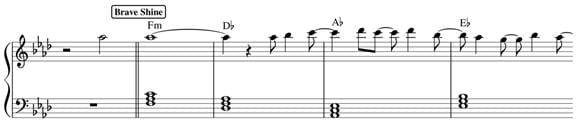
What do ADAMAS from Sword Art Online and Brave Shine from Fate share in common? One common feature is that they use the same chord progression in the chorus:
|
ADAMAS |
C♯m |
A |
E |
B |
|
C#
minor: |
i |
VI |
III |
VII |
|
Brave Shine |
Fm |
D♭ |
A♭ |
E♭ |
|
F
minor: |
i |
VI |
III |
VII |
They both use the (i/VI/III/VII) chord progression.
The Roman numerals refer to the chord on that scale degree of the home key. It’s probably easier to explain with a picture. For C major and C minor, the Roman numerals represent these chords:




Uppercase Roman numerals represent major chords, while lowercase Roman numerals represent minor chords. These are very useful in understanding chord progressions as they don’t depend on the home key.
Now, change the second half of that progression a bit and you have another common progression (i/VI/VII/III-VII):
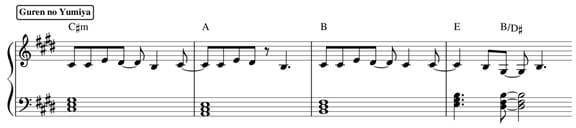
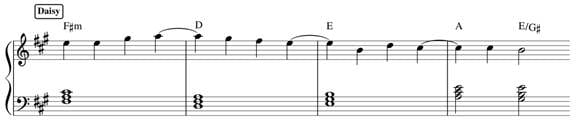
|
Guren no Yumiya |
C♯m |
A |
B |
E |
B/D♯ |
|
C♯
minor: |
i |
VI |
VII |
III |
VII |
|
Daisy |
F♯m |
D |
E |
A |
E/G♯ |
|
F♯
minor: |
i |
VI |
VII |
III |
VII |
Now what can we do with this information? Let’s choose ADAMAS and Guren no Yumiya, since they are in the same key (C♯ minor) and also similar tempo (190 BPM and 180 BPM). If we write out a few more bars of the chorus, we notice that the progression repeats one more time:
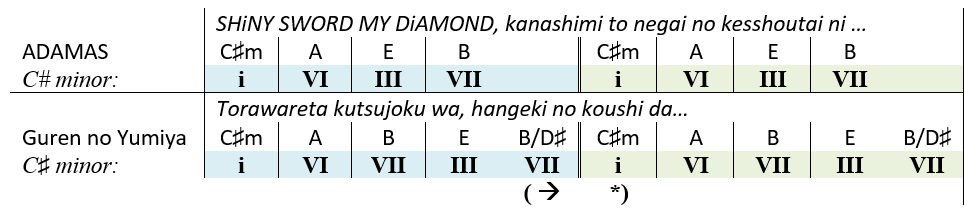
From the progression, we can notice that VII is followed by i. It sounds natural and pleasant, so we can say that VII resolves to i nicely. Now we can use this fact to write our first transition – use the end of ADAMAS (VII) to pivot to the beginning of Guren no Yumiya (i):

Same major / minor key (Difficulty: ♪)
It’s the easiest if song A and song B are in the same key. The first method is to look for a song that starts on the chord the previous song ends on, such as from Gurenge to this game.
In Gurenge, the first half of the chorus ends on E minor (i of E minor), which is also the first chord of the chorus of this game. As a bonus, even the melody shares the same note (B)! This makes the transition simple and seamless.
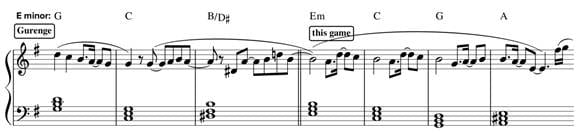
Here’s a fancy chart to make it seem more complicated than needed:
|
Gurenge |
G |
C |
B/D♯ |
Em |
|
|
|
|
E
minor: |
III |
VI |
V |
i |
|
|
|
|
this game |
|
|
|
Em |
C |
G |
A |
|
E
minor: |
|
|
|
i |
VI |
III |
IV |
The E minor chord (i of E minor) is the common chord used to pivot the transition.
Review
After finishing the first draft of the sheets, I’ll record a first draft, listen to it many, many times and fine-tune the details of the arrangement. If necessary, I may have to completely rewrite parts of it.
Eventually, the sheets are finalized, and I’m ready to start recording!
Nayu's Note: And that was the end of what HalcyonMusic had wrote! Unfortunately, he's gotten much busier since then, so the continuation of this post shall remain to be seen...
If you liked this post, feel free to share it on social media! Thanks for your support!
Follow HalcyonMusic on: https://linktr.ee/HalcyonMusic