It’s been a while since I last wrote a blog post about my arrangements! In fact, it has been so long that I actually lost my old blog, and five years have somehow slipped by.
I used to share arrangement details in my YouTube video descriptions, but it’s always tough to discuss subtle nuances and technical details without proper visual aids. On the flip side, writing a full-length post like this takes a lot more time and effort—so, uh, we shall see how this goes! :)
But enough rambling. Let’s kick things off with one of my recent arrangements! I won’t call it my absolute favourite (since I genuinely love most, if not all, of my pieces), but it definitely has a few unique elements that are worth diving into.
That arrangement is Starry Sea, one of the insert songs from the insanely popular movie, Cosmic Princess Kaguya! You can listen to my arrangement right here, or find it on your favourite streaming services.
Arranged by YXY Piano Covers / Nayu - Aqu3ra/星降る海 (Cosmic Princess Kaguya! Insert Song)
My sources of reference
Typically, when I work on a new arrangement, I start with the official releases available on streaming platforms. For most Anime Openings and Endings (OPs/EDs), the TV-size and full-length versions differ structurally. These changes can range from modified intros to a variation in the number of verses, pre-choruses, or post-chorus sections.
The most common way studios "cut" a full-size song down to TV-size is by shortening the intro and seamlessly splicing the end of the first chorus directly into the final chorus and coda (and sometimes, the coda is skipped or heavily trimmed entirely).
For example, if we look at the Fall 2024 opening theme for Blue Box by Official HigeDANdism, we can see a clear difference in the structural layout:
- Full Version: Intro → Verse I → Verse II → Pre-Chorus → Chorus → Verse III → ... → Chorus → Coda
- TV-Size: Intro (Shortened) → Verse I → Pre-Chorus → Chorus → Coda (Shortened)
The take-home message here is that a TV-size version rarely adds or modifies elements from the full song to create a new artistic effect; usually, it just subtracts.
Which brings us to why Starry Sea is a little special.
The short "Sing Along" version mostly follows a standard TV-size cut, with one major exception: it didn't need to shorten the intro. Since it was an insert song rather than an OP/ED, it didn't have to conform to the strict ~1:30 television runtime. Instead, it modified the intro by completely stripping away the heavy accompanying instrumentals found in the full version.
I can completely see why the production team made this creative choice. In that specific movie scene, the shot of Yachiyo standing alone at the top, singing, evokes such a powerful, isolated feeling. A solo vocal encapsulates that atmospheric vulnerability perfectly.
Because of that emotional impact, I decided to reference the short version's isolated intro for my own arrangement, rather than replicating the full-version instrumentals. From that point onward, the rest of the arrangement transitions back to the official full version.
Piano Accompaniments
Before we start dissecting the actual sheet music, let’s talk briefly about the role of the left hand in anime and J-Pop piano arrangements. In my opinion, a good accompaniment serves three core purposes:
- Providing the Chord Harmony: Establishing what I call the "context" of a particular bar.
- Translating the Energy: Communicating the emotional state of the song at that exact moment. Is it heavy, light, intimate, driving, happy, or sad?
- Anchoring the Bassline: Transcribing the original song's bass guitar or synth lines so the arrangement feels grounded.
For now, I won't go into hyper-specific detail since my arrangement of Starry Sea doesn't feature massive variations in accompaniment styles. We can save those deep dives for a future post on a more complex arrangement!
Let’s look at how these rules played out in this piece. In the intro section, the original track features a very gentle touch as the music slowly builds toward the next section. To mirror this, I used gentle, broken arpeggios.
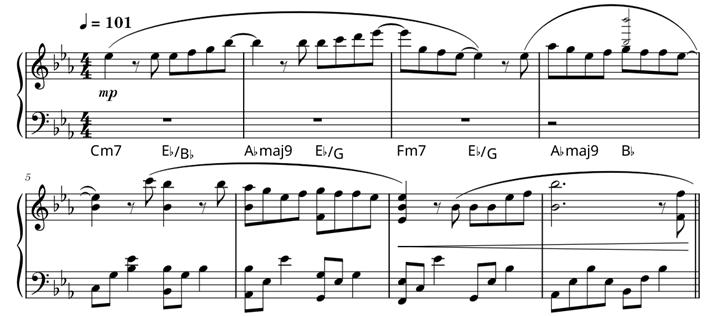
I wanted to keep the left-hand patterns relatively simple to ensure they didn't overwhelm the main melody, making the section highly accessible to play while preserving its delicacy.
When arranging for solo piano, the physics of the instrument dictates how we structure accompaniments. In a quiet intro, using broken arpeggios instead of block chords accomplishes two things: it thins out the harmonic texture so it doesn't sound dense, and it spaces the notes out over time.
Furthermore, by keeping the left-hand arpeggios in a lower-middle register and the melody higher up, we create register separation. This prevents the lower overtones of the piano from bleeding into the primary melodic frequencies, ensuring the melody sounds pristine and crystal clear.
Contrast this with the chorus, where the energy spikes. The drums kick in, and the full instrumental ensemble comes together to elevate the track. To translate this shift, the arrangement relies on wider dynamics (playing louder) and much heavier block-chord textures.
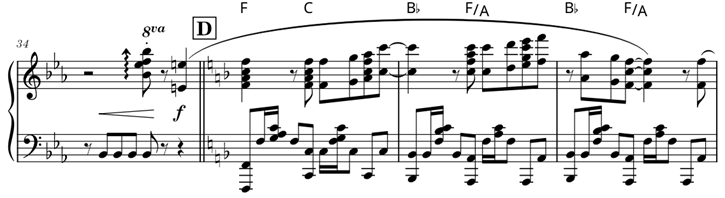
Even the choice of octaves plays a massive role in managing the song's energy. When a section needs to feel quiet and reflective, the accompaniment should either use fewer notes (dropping full triads down to simple intervals) or shift to a higher octave entirely. You can see this clearly during the bridge at measure 72.
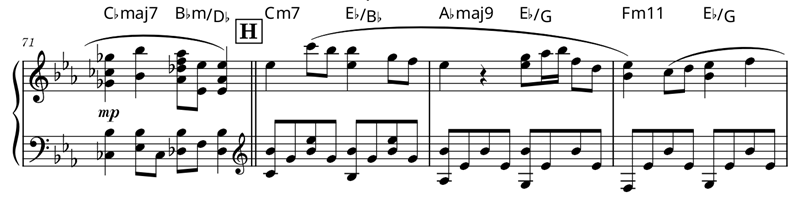
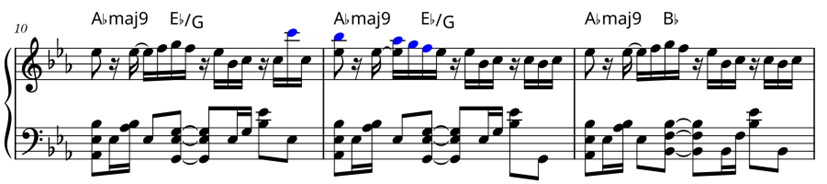
Apart from establishing harmonic context, the accompaniment is responsible for driving the rhythm of the track. For instance, the second part of the intro (Section A, at the 0:18 mark of the sing-along version) introduces a prominent syncopated beat.

The game plan here was to use rhythmic block chords to anchor that syncopation, which you can see happening directly in the left hand at measure 9.

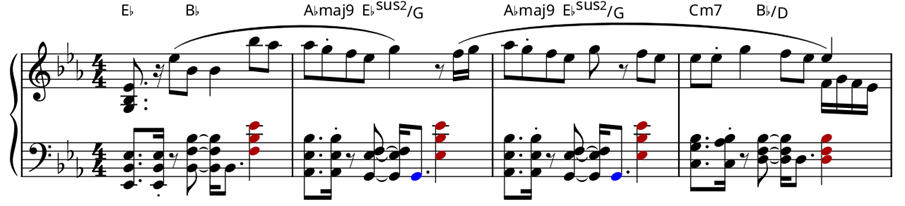
Moving into the verse, the beat rhythm changes again. Keen ears will probably notice that the original instrumental background sounds slightly different from my piano adaptation. I intentionally modified the bass note on the final beat (highlighted in blue below) so that each bar only contains two primary chord changes.

I chose to alter the bassline because forcing a solo piano to change chords on every single beat in this specific context can easily make the performance sound muddy or cluttered.
Another major structural change I made was adding an extra chord on the fourth beat (the notes highlighted in red), even though the original track leaves this space completely empty of harmony. The original song fills this space with a physical clap. While other arrangers might emulate a clap with a lighter textures like a finger snap (a classic move by HalcyonMusic) or a high-register staccato chord, I opted for a full triad.
This comes down to a personal philosophy: the concept of "space" on a solo piano is far less forgiving than it is in a multi-instrumental track.
In a studio production, producers can create space by letting elements ring out, washing them in reverb, or letting the natural decay of an acoustic guitar fill the air. On a piano, you don't have an entire mix engine backing you up. Without that extra chord defining the fourth beat, certain bars would feel like the music completely stops dead in its tracks, creating a clunky, awkward gap in the performance. By inserting that triad, the momentum stays alive.
The remaining sections of the song follow a similar logic, using targeted accompaniment patterns to emulate the driving force of the bass drums. I’ll leave those specific measures there for now—perhaps I'll write a dedicated post on emulating complex drum grooves and rhythms in the future, assuming I'm hardworking enough to type it all out!
Countermelodies, and the little details
One of my absolute favourite parts of the entire arrangement process is finding clean ways to weave hidden countermelodies and background details into the piano score. When I arrange, these elements usually take a lower priority—I only look for them after the primary melody, bassline, and core chord harmonies are fully established. The reality is that most casual listeners focus entirely on the main vocals, so these embellishments are purely for the eagles-eyed musicians in the room.
So, let’s take a peek at what I slipped in this arrangement!
I'm not sure if many people noticed during the video, but the notes highlighted in blue reference a subtle sub-melody hidden deep in the original studio instrumental mix. I simply adjusted the octaves slightly to ensure the pattern remains ergonomic and comfortable for your hands to execute.
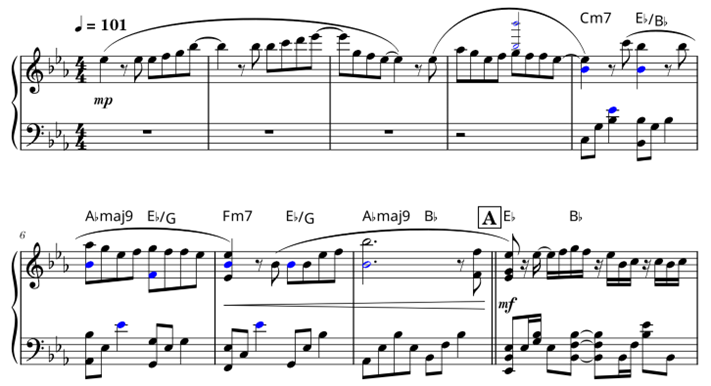
I also made sure to write in Yachiyo’s vocal hums during the intro section:
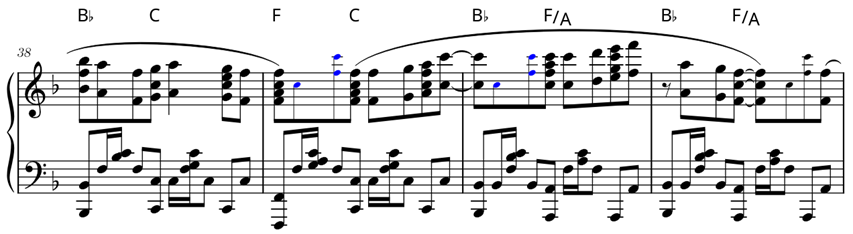
In the second half of the chorus (measure 39), the piano in the original soundtrack begins playing a beautiful, rapid repeating motif: F4 C4 C5 C4. I took inspiration directly from that sequence and wove it right into the open gaps of the main vocal melody.
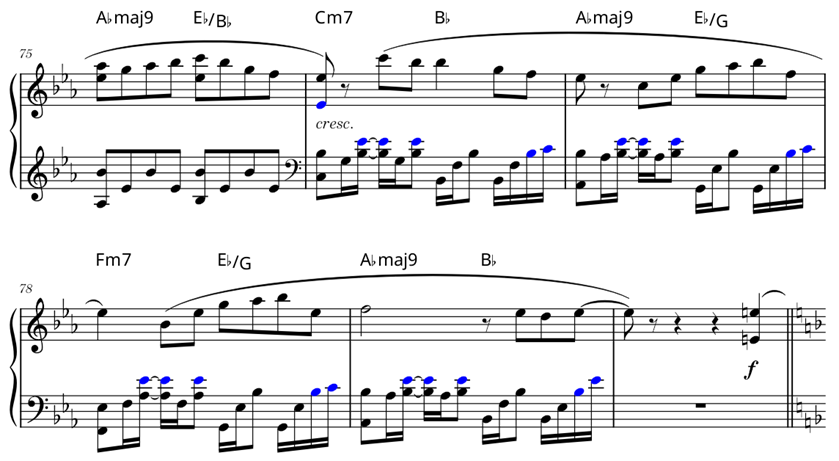
Finally, during the bridge at measure 76, I transcribed and integrated the soaring sub-melody originally performed by the electric guitar:
Wrapping it up
All in all, I had an absolute blast working on this piece. In recent years, I’ve been trying to find a healthier balance between the physical performance difficulty of an arrangement versus its textural richness—finding the sweet spot of how detailed or "accurate" a piano cover needs to be. Every musician has their own philosophy on where that line sits, and it’s something I find myself actively adjusting with every single track I print.
It’s always fascinating to see how different creators interpret the exact same source material. I love listening to alternative covers of songs I’ve worked on just to see how other minds solved the same musical puzzles. Sometimes it validates my choices, and other times I realize their arrangement features a brilliant spark of creativity that I can totally steal—er, draw inspiration from—for my future projects!
For this track, you can check out HalcyonMusic’s great simplified version, or explore alternative takes like TYPICAL JIN’s interpretation. They are well worth a listen! Of course, if you ask me which one I prefer, I'm going to tell you it's my own... but hey, I'm biased 😈.
I hope you enjoyed this mini write-up! If you found these insights cool or useful, please feel free to share the post around or drop your thoughts below.
See you in the comments section, or in the next post!